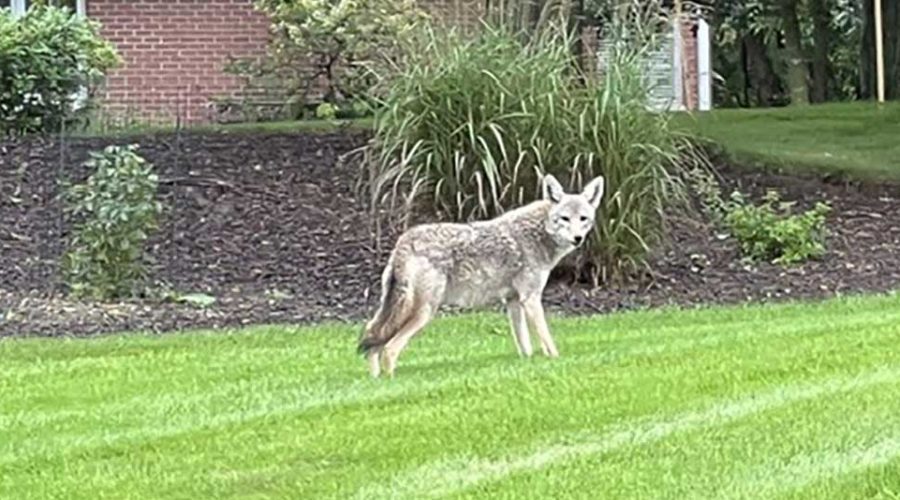
One or more coyotes have been seen actively moving about the Overlook Lakes property in broad daylight. Although these animals serve a vital role in maintaining a balanced eco-system, those with small dogs may wish to be vigilante while on walks through the surrounding property and neighborhood.
The fact that Overlook Lakes is adjacent to the Root River parkway, blesses us with a plethora of wildlife on our grounds, that may be both beneficial and bothersome. As always we recommend that residents refrain from feeding wildlife, and ask that you notify us of any pest that becomes a nuisance.
The internet indicates that “air-horns” and “whistles” may be effective in warding off coyotes, and perhaps worthwhile to carry while walking alone or with small pets.
A representative of the US Fish & Wildlife Service expressed unexpected concerns about bird feeders. Feeders share bacteria, spread certain diseases among birds, attract predators, and often end up feeding rodents and scavengers more than birds around homes. So why do many among us love bird feeders? To quote a wildlife expert: “The birds don’t need the feeders. Some people do.” we at Overlook Lakes understand that.
Our Founders gave us rules about bird feeders, rules that make sense to minimize problems for our buildings and residents—and wildlife. Our governing documents are simple and clear on this topic.
Here are the basic rules:
All bird feeders must be kept in a neat and clean condition.
No bird feeder may be directly attached to any part of a building.
All units are limited to one feeder each.
Bird feeders must use Niger (sometimes “Nyjer”) thistle seed only.
Wise and helpful guidance! We’re bringing this up at this time because several feeders we’ve seen are filled with food (e.g., cracked corn, sunflower seed, cheap mixes) that are largely spilled on the ground and attract rodents and small critters. That’s a no-no. Remember, only Niger/Nyjer thistle seed may be used. It’s 100% edible and leaves no mess on the ground. That ultimately leads to all of us enjoying more birds around us.
It’s been great to see our community out walking and bicycling our beautiful development!
It has been brought to the attention of the OLCA community that while most people give “walkers” and bicycle riders a “wide berth” when driving past them, there are a few who are clearly driving at an unsafe speed.
If you have light fixtures that suddenly flicker sporadically or do not work as intended, here are some good troubleshooting procedures from easy to more involved:
Check for loose light bulbs that can be tightened.
Make sure you are not using non-dimmable lightbulbs with a dimmer switch.
Replace damaged light fixture that may have damaged light sockets from years of replacing light bulbs. Be sure to turn off circuit at circuit breaker before inspecting or working.
Replace damaged light switch. Also be sure to turn off circuit at circuit breaker before inspecting or working.
Wisconsin law requires residential occupancies, including condominiums, install carbon monoxide alarms. The law states that CO alarms are required on residences having fuel burning appliances, fireplaces, or attached garages. The alarms must be installed within 15 feet of each sleeping area of the fuel burning appliance. While contractors are required to install hard-wired CO alarms in all new construction, owners in existing buildings must install their own alarms. Because Overlook Lakes units have gas furnaces, we are required to comply with the law.